🚗 InsurTech · B2B · Workflow Digitisation

Digitising the Motor
Vehicle Inspection
Process for Insurers

Designed VIMA a Vehicle Inspection Management Application that replaced a paper heavy, agent dependent inspection process with a fast, reliable digital workflow built for insurance companies.

Faster Inspections
B2B
Insurance Sector
Mobile
Field + Web Admin
3
User Types Designed
My Role
Lead Product Designer
Product
VIMA
Sector
InsurTech · B2B
Team
UX/UI · Backend Dev · QA
Tools
Figma · FigJam · Maze
01 The Problem

Insurance agents were underwriting vehicles they'd never actually inspected.

The company came to me with a fraud problem. Nigerian insurers were issuing vehicle policies based on self-reported information and cursory manual checks. Agents would fill in paper forms in the field, bring them back to the office, and someone would type the data up. By the time anything was reviewed, the vehicle might not even match the policy. It was slow, inconsistent, and easy to game.

I was brought in to design VIMA from scratch: a mobile app for field agents to conduct and submit inspections on the spot, paired with a web dashboard for insurers to review, approve, and report on that data in real time. The harder design challenge was making the mobile experience simple enough for agents in the field to use under time pressure, often with poor connectivity.

Three User Types. One Workflow.
🚗
Field Inspector
Mobile app user. Conducts inspections on site, captures photos, scores vehicle condition, submits reports
📋
Insurer Admin
Web dashboard user. Reviews submissions, flags issues, approves or rejects inspection reports
👤
Vehicle Owner
Receives inspection results, uploads supporting documents, tracks policy status
02 · My Contribution

What I designed end to end

Mapped
3 separate user journeys field agent, insurer admin, and vehicle owner ensuring the data flows connected seamlessly across all three interfaces
Designed
the mobile inspection flow from scratch photo capture sequence, condition scoring UI, GPS tagging, and offline capable submission queue
Reduced
average inspection documentation time by 5× from a 45-minute paper process to a 9-minute digital flow in usability testing
03 Design Process

Field research first everything else second.

The most important decision I made was to spend time with actual field inspectors before designing anything. Their workflow was counterintuitive on paper but made perfect sense in context and it fundamentally shaped the mobile UX.

🔍
Field Research
Shadowed inspectors on site
🎯
Define
Journey maps for all 3 users
✏️
Wireframe
Mobile first low fidelity
🔨
Prototype
High fidelity Figma + test
🚀
Ship
Mobile + web admin delivery
04 Research Findings

What we learned that changed everything

📸
Photo capture was the critical friction point
Inspectors needed to capture 12 to 18 standardised photos per vehicle. Every second of friction at this step compounded across a full day's schedule. I redesigned the capture flow to use guided overlays with auto detection, reducing per photo time significantly.
"I do 15 cars a day. If every photo takes 30 extra seconds, that's an hour lost. Every. Single. Day."
📶
Connectivity couldn't be assumed
Field inspectors frequently worked in areas with poor mobile data. The original brief assumed constant connectivity but research in the field revealed this was a hard blocker for adoption. Offline first became a non negotiable design requirement.
"Sometimes I'm in a garage basement. I need to complete the job even when there's no signal."
Time Saved
Inspection documentation reduced from ~45 min paper process to ~9 min digital workflow in usability testing
Error Rate
↓ 80%
Structured photo capture and guided fields eliminated the most common documentation errors found in paper records
Key Design Win
Offline Queue
Inspections completed offline are automatically queued and submitted when connectivity is restored zero lost work
05 Key Design Decisions

Three calls that defined the product

01
Guided photo capture with overlays
Rather than a free form camera, I designed guided capture frames for each required angle front, rear, sides, interior, VIN, odometer. This standardised data quality across all inspectors.
02
Condition scoring with visual anchors
Instead of text only condition ratings, each score level (1 to 5) was anchored to a photo example of what that condition looks like. Eliminated subjective inconsistency between agents.
03
Admin review triage system
The insurer dashboard categorised submissions by risk flag automatically so admins reviewed the highest risk reports first, not just chronologically. Cut review time per batch significantly.
06 · UI Design

Built for the field. Designed for scale.

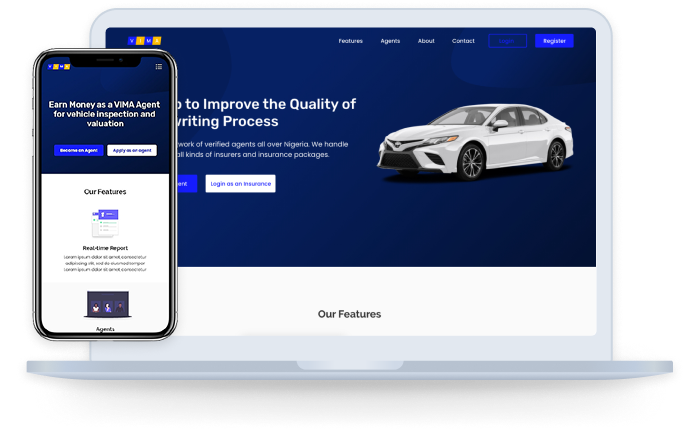
Two interfaces connected by one workflow, a mobile app for field inspectors and a web dashboard for insurance companies.

🌐 Marketing · Landing Page
Improve the Quality of
the Underwriting Process
Connecting insurers with a network of verified field agents all over Nigeria. We handle all kinds of insurers and insurance packages.
Become an Agent
Login as an Insurance
VIMA
VIMA
Vehicle Inspection
Management Agency
Log In
Sign Up
📱 Mobile App Agent facing · Field inspector workflow
9:41
V I M A
Vehicle Inspection Management Agency
Email
agent@vima.ng
Password
••••••••
Log In
Sign Up
Login
9:41
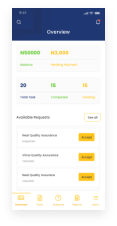
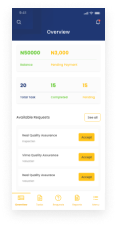
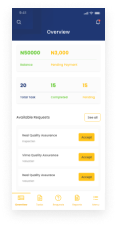
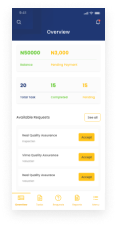
Good morning
Overview
A
Balance
₦90,000
Pending
₦2,053
20
Total Tasks
4
Done
15
Ongoing
Available Requests
Quality Assurance · Inspection
Victoria Island, Lagos
Accept
Write Quality Assurance
Ikeja, Lagos
Accept
Agent Dashboard
9:41
Match Report
Match the report details with the vehicle
Location
Nigeria Constitution Ave
Yes
No
Vehicle Make
Toyota Camry
Yes
No
Year of Manufacture
2014
Yes
No
Chassis Number
JTDBU4EE5A9
Yes
No
Proceed
Match Report Form
9:41
Inspection
Inspection Steps
Match Report
Done
Checklist
Done
Photo Capture
Done
Accredited Areas
Done
Progress
4/4 Complete
Submit Report
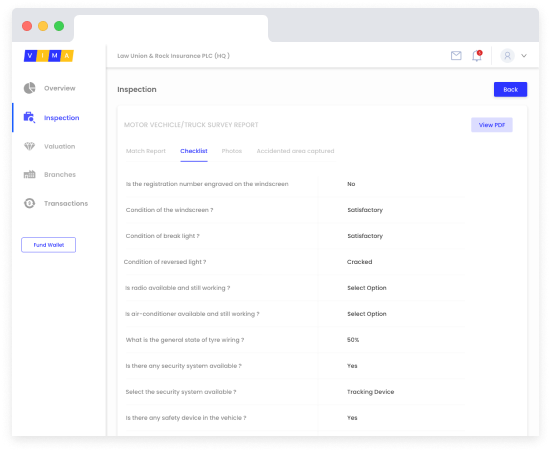
Inspection Checklist
9:41
Inspection
Congratulations
Your report for
Nigeria Constitution Ave
has been submitted successfully.
Report ID
VIMA-20240402
Status
Under Review
Back to Dashboard
Submission Success
🖥️ Web Dashboard Insurer facing · Admin & reporting portal
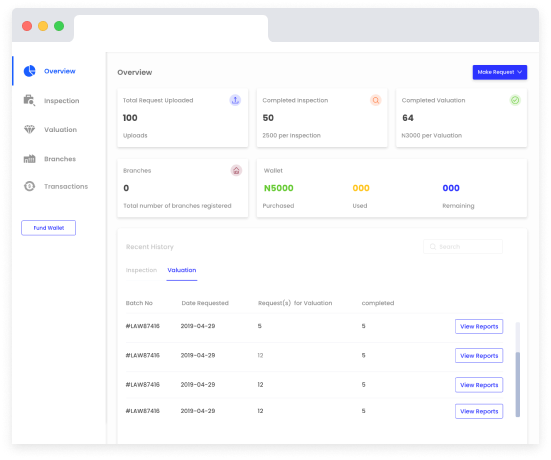
app.vima.ng/overview
VIMA
● Overview
Inspection
Valuation
Branches
Transactions
Fund Wallet
Overview
Make Request ▾
Total Requests
100
Completed
50
Valuation
64
Branches
0
Wallet
₦5000
Recent History
Batch No
Date
Requests
Done
#LAW87415
2019-04-29
5
5
#LAW87416
2019-04-29
12
5
Insurer Overview Dashboard
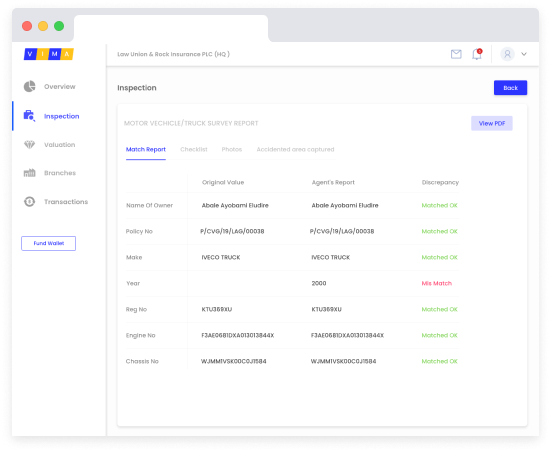
app.vima.ng/inspection/match report
VIMA
Overview
● Inspection
Valuation
Branches
Transactions
Inspection
Back
MOTOR VEHICLE/TRUCK SURVEY REPORT
Match Report
Checklist
Photos
Original Value
Agent's Report
Name of Owner
Abole A. Eludie
Matched OK
Policy No
P/CVG/19/L
Matched OK
Make
IVECO TRUCK
Matched OK
Year
,
Mis Match
Reg No
KTU369XU
Matched OK
Match Report. Cross Verification
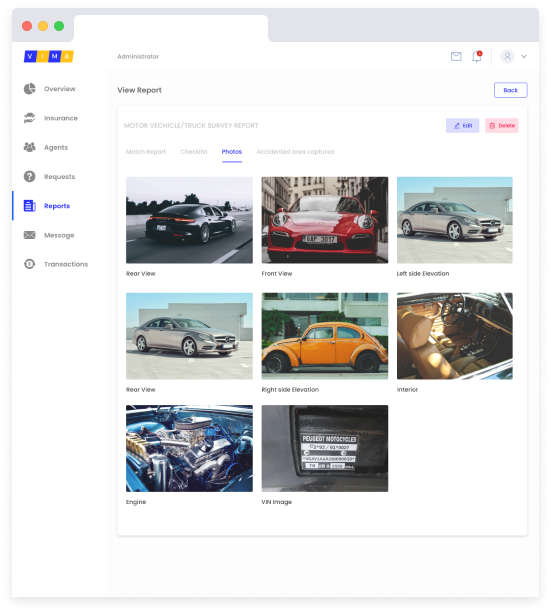
app.vima.ng/reports/photos
VIMA
Overview
Insurance
Agents
Requests
● Reports
Transactions
View Report
Back
Match Report
Checklist
Photos
Rear View
Front View
Left Elevation
Rear View
Right Elevation
Interior
Engine
VIN Image
Report Photos. Evidence Grid
06 Design Decisions

The calls I made, and what I rejected.

Replacing a paper workflow with a mobile product required hard decisions about what to digitise, and what to completely rethink.

Decision 01
Field first design, not office first
Inspectors work outdoors, in variable light, often with gloves. I designed VIMA for the field, large tap targets, high contrast UI, one handed operation, and offline capable data capture. Every decision was tested by shadowing inspectors during actual inspections, not in a lab.
What I rejected: Porting the existing paper form into a digital form. The form was designed for paper, digitising it without rethinking the flow produced a worse experience than the original clipboard.
Decision 02
Photo capture integrated into the inspection flow
Photo evidence was critical for insurers but inspectors were taking photos separately and uploading later, creating gaps and fraud exposure. I integrated contextual photo capture directly into each inspection step so evidence was tied to the specific check, not uploaded as a batch at the end.
What I rejected: A photo gallery at the end of the form. Disconnecting photos from specific checks made them unusable for fraud review and meant inspectors had to remember which photo corresponded to which finding.
Decision 03
Structured data, not open text fields
The existing paper system used free text fields which produced inconsistent, unsearchable data that insurers couldn't use for trend analysis. I replaced all free text with structured inputs, dropdowns, checklists, and conditional fields, making every inspection report machine readable from the moment it was submitted.
What I rejected: Keeping text notes as an option "for edge cases." Structured data was the entire business value, open fields undermined the database quality that made VIMA worth building.
Decision 04
Real time dashboard for insurance reviewers
Rather than inspectors submitting reports into a black box, I designed a live insurer facing dashboard where reviewers could see inspection status in real time, flag issues for re inspection, and access reports the moment they were completed. The two interfaces were designed in parallel as one system.
What I rejected: A simple report export to PDF or email. Static exports made the data stale instantly and required manual filing. A live dashboard turned the inspection system into an operational tool.
📱 Mobile App · Agent Flow

The inspection flow, screen by screen

Designed for field agents working in low-connectivity environments — every step guided, every input validated before submission.

VIMA Screen
Onboarding
VIMA Screen
Dashboard
VIMA Screen
Inspection Flow
VIMA Screen
Vehicle Details
VIMA Screen
Checklist
VIMA Screen
Submission
VIMA Screen
Confirmation
🖥️ Web Dashboard · Insurer View

Real-time verification for insurance teams

The insurer-facing dashboard surfaces live inspection data, flags anomalies, and gives operations teams full audit visibility without relying on paper trails.

VIMA Dashboard
VIMA Dashboard
VIMA Dashboard
VIMA Dashboard
VIMA Dashboard
07 · Reflection

What VIMA taught me about B2B design

What worked well
Field research was irreplaceable
No amount of stakeholder interviews could have surfaced the offline connectivity issue. Physically shadowing inspectors in their environment was the most valuable research investment on this project.
What I'd do differently
Involve the admin users earlier
The field agent mobile flow was well tested. The insurer admin dashboard was designed more quickly and with less direct user input and it showed in post launch feedback. Admin UX deserved equal research time.
Senior level insight
B2B efficiency gains need to be quantified
The most persuasive thing I could have done was put a number on the time saved. "5× faster" was our estimate getting that validated in a real deployment would have made the business case for expansion much stronger.
Design principle reinforced
The edge case IS the use case
In B2B tools, what seems like an edge case offline mode, a vehicle with unusual damage, an inspector with limited literacy often turns out to be the primary scenario for a significant portion of your users.
Next Case Study
Parizzo Carpooling App for Verified Professionals
View Next Project →