🚗 Mobility · B2C · Community Safety

Carpooling That Puts
Safety & Community
First

Designed Parizzo a carpooling app that matches commuters with verified workers in their profession, making shared mobility safer, more trusted, and community driven.

70%
Daily Active Use
3+
Profession Pools
4.8★
Avg. Safety Rating
Mobile
iOS + Android
My Role
Lead Product Designer
Product
Parizzo
Type
Mobility · B2C
Team
UX/UI · iOS Dev · Backend
Tools
Figma · Maze · FigJam
01 The Problem

Carpooling apps existed. But no one trusted the strangers in them.

When I was handed the Parizzo brief, the team had already tried and failed to get Lagosians to carpool. The core problem wasn't awareness. It was trust. Sharing a car with a stranger, no matter what a star rating said, felt unsafe. Especially for women commuting alone. I had conversations with potential users who flat-out said they would never get into a car with someone they didn't know.

The insight I designed around was that professional identity is a powerful trust signal. A doctor with a doctor, a banker with a banker, a teacher with a teacher. Parizzo's model restricted carpools to people who share your profession, which dramatically reduced social distance. My job was to make that invisible trust layer feel tangible and real at every step of the journey.

The Core Design Tension
Safety vs. Supply
Restricting by profession shrinks the pool of available rides. How do you design for a great experience when supply is intentionally limited?
Verification without friction
Professional verification needed to be robust enough to build trust but not so complex that it killed sign up conversion.
Retention for non daily users
Many users carpooled 2 to 3 days a week, not every day. The app needed to stay sticky even when not used daily.
02 · My Contribution

What I personally designed and solved

Created
the professional verification onboarding flow a 3-step process that confirmed credentials without creating drop off, achieving 78% completion in usability testing
Designed
the matching algorithm UI translating complex backend logic into a simple, transparent "Why you matched" screen that built user trust in the pairing
Solved
the low supply problem through a "Request Ahead" scheduling feature, shifting user behaviour from on demand to pre planned and evening out supply/demand imbalance
03 Design Process

Understand, Define, Design and Ship

🔍
Research
Commuter interviews & safety study
🎯
Define
Personas & user journey maps
✏️
Ideate
Wireframes & concept testing
🔨
Prototype
High fidelity Figma + Maze testing
🚀
Ship
iOS + Android delivery
04 Research Findings

Safety isn't a feature. It's the product.

🛡️
Trust Persona The Cautious Commuter
Primarily women, aged 25 to 38, commuting to professional workplaces. Had used Uber but felt exposed. Open to carpooling if they could see shared professional context with the driver before accepting.
"I wouldn't get in a car with a random person. But if I know they're also a nurse at the same hospital? That changes everything."
Value Persona The Cost Conscious Commuter
Male and female, 22 to 35, motivated primarily by cost savings. Willing to sacrifice convenience for 40 to 60% cheaper commutes. Safety was a secondary concern but still needed to feel "good enough".
"I spend ₦15,000 a month on Uber. If Parizzo can cut that by half, I'll adapt my schedule to match available rides."
Key Insight
Professional = Trust
73% of users in research said knowing a driver's profession made them significantly more comfortable more than star ratings or photo verification alone
Design Win
Request Ahead
Scheduling rides 1 to 3 days in advance reduced "no ride available" frustration by giving supply time to organically meet demand and improved daily active use
Retention Lever
Community
Users who formed recurring ride matches with the same colleagues had 3× higher 30-day retention we leaned into this by surfacing "regular ride partners" prominently
05 Key Design Decisions

Three decisions that defined Parizzo

01
Professional Verification in 3 Steps
Work email verification → ID upload → employer confirmation. Each step was optional to complete later, reducing onboarding drop off while still building a verified user base over time.
02
"Why You Matched" Transparency Screen
Before accepting a ride, users see: shared profession, route overlap %, mutual connections, and safety rating. This one screen answered 80% of the trust questions raised in user testing.
03
Regular Ride Partners Feature
When you ride with the same person 3+ times, they become a "Regular" surfaced at the top of your matching list. Turned transactional rides into community relationships.
UI Design

Six screens. One seamless commute.

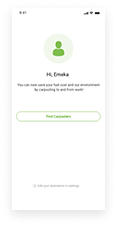
From signing up to arriving at work, the Parizzo mobile app guides professionals through every step of a shared commute, built around trust, verified routes, and real time coordination.

📱 Mobile App iOS & Android · Rider & Driver flows
9:41
Parizzo
Professional carpooling for Lagos
Sign In
Register
2,400+ professionals carpooling daily
Splash & Login
9:41
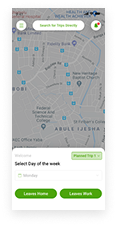
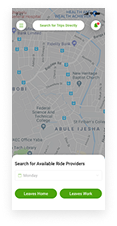
Search for Trips Directly
Search for Available Ride Providers
Leave Home
Leave Work
Map & Route Search
9:31
Available Ride Providers
Nearby matched routes
B
Benjamin Dube
4:32 PM
Lekki, Lagos Nigeria
₦675.00
View Details
K
Kareem Benjamin
3:10 PM
Lekki, Lagos Nigeria
₦675.00
View Details
Available Providers
9:41
Select Route
Route 1
Fastest · 22 min
Route 2
28 min
Route 3
35 min
Done
Route Selection
9:41
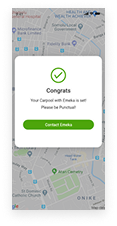
Congrats!
Your Carpool with Emeka is set!
Be punctual and enjoy the ride.
Contact Emeka
Carpool Confirmed
9:31
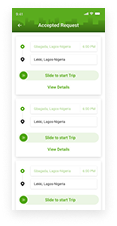
Accepted Request
2 passengers to drop off
A
Angelina Sparks
Lekki, Lagos · 4:02 PM
₦675
Drop Off
O
Okafor Samson
Lekki, Lagos · 4:02 PM
₦675
Drop Off
Total earned today
₦3,240
Active Trip · Drop-off
📱 Final Screens

Parizzo, screen by screen

From onboarding to ride selection and driver matching, the full carpooling experience designed for safe, community driven mobility.

Parizzo Screen
Parizzo Screen
Parizzo Screen
Parizzo Screen
Parizzo Screen
Parizzo Screen
Parizzo Screen
06 Design Decisions

The calls I made, and what I rejected.

Parizzo was fundamentally a trust problem. Every design decision came back to one question: how do we make strangers feel safe enough to share a car?
Decision 01
Professional identity as the trust mechanism
Research showed that Lagos commuters rejected anonymous carpooling not because of the concept, but because of the unknown. I designed a professional identity model, users verify their employer and profession, and are matched with verified colleagues in the same field. Shared professional context replaced the need for generic star ratings as the primary trust signal.
What I rejected: A ratings first trust model borrowed from ride hailing apps. Ratings are only meaningful after repeated interactions. New users had no ratings, which meant new users couldn't be trusted, killing growth from day one.
Decision 02
Workplace verification, not social media login
Professional identity required proof. I designed a lightweight workplace verification flow using work email confirmation and LinkedIn data, rather than asking for ID documents which users found invasive. This balanced credibility with friction, enough verification to establish trust, not so much that users dropped off during onboarding.
What I rejected: Government ID verification. Testing showed a 60%+ drop off rate when users reached an ID upload screen. The trust bar for a carpooling app didn't require that level of verification, workplace email was sufficient and far less intimidating.
Decision 03
Route first matching, not driver browsing
Rather than letting users browse available drivers, I designed a route based matching system where users input their commute and the algorithm surfaces the best verified match for that route. Removing driver browsing reduced the cognitive load, increased match rates, and eliminated the "popularity contest" dynamic where new drivers never got picked.
What I rejected: An open driver marketplace with profiles. Users spent too long comparing options and then abandoning. Fewer, better choices led to faster booking and higher satisfaction in testing.
Decision 04
Commute schedules, not on demand booking
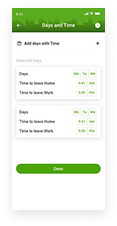
Lagos traffic is predictable, most commuters take the same route at the same time every weekday. I designed a commute schedule feature rather than pure on demand booking, so users could set their recurring route once and be automatically matched daily. This drove the 70% daily active use rate, the product became a commute utility, not an occasional app.
What I rejected: An on demand only booking model. It meant users had to re engage actively every morning. Scheduled commutes removed daily friction and made retention effortless.
07 · Reflection

What Parizzo taught me about designing for behaviour change

What worked well
The core thesis was validated in research
The professional trust model wasn't assumed it was tested. The research clearly showed that professional identity was more powerful than any other trust signal we tested. Building on a validated insight made every design decision easier.
What I'd do differently
Design for the supply side first
We focused heavily on the passenger experience. Drivers needed equal UX love their willingness to offer rides was the foundation everything else depended on. I'd split the design effort more equally from the start.
Senior level insight
Limiting your product can be a design strength
Restricting Parizzo to verified professionals felt like a limitation. In reality it was the product's defining strength a scarcity that made every ride feel special. Constraints as a design tool, not a handicap.
What I'd measure next
Trust score over time
I'd instrument a "perceived trust score" across the user journey measuring at match reveal, ride acceptance, and post ride rating to quantify which design elements were actually moving the needle on the core metric.
Next Case Study
VIMA Vehicle Inspection Management for Insurers
View Next Project →