🏛️ Civic Tech · B2C · Government Accountability

Making Government
Accountable to the
Citizens Who Fund It

Designed a civic platform enabling Nigerian citizens to track, monitor, and give feedback on government project implementation putting transparency directly in the hands of the public.

3K+
Active Citizens
4
Gov. Agencies
Mobile
Web + App
2
Designers
My Role
Lead Product Designer
Platform
Tracka
Type
Civic Tech · B2C
Team
UX/UI · Dev · Community
Tools
Figma · Maze · Miro
01 The Problem

Citizens had no way to hold their government to account on project delivery.

BudgIT brought me in to design Tracka because they had identified a problem that had frustrated Nigerians for years: nobody knew where their tax money was actually going. Roads half-built. Schools left incomplete. Projects marked "done" with nothing to show for it. Citizens had no way to push back, and the government had no real accountability mechanism.

My challenge was to give those citizens a genuine voice. Not just a complaints box, but a structured channel to discover projects in their area, follow them for updates, and submit feedback that actually reached the responsible agencies. It had to work for someone with basic smartphone literacy, not just tech-savvy activists.

Core Design Challenges
1
Low digital literacy users
Design for citizens who may not be tech savvy but need full access to all features
2
Trust and credibility
Platform had to feel legitimate enough for both citizens and government agencies to use
3
Closing the feedback loop
Feedback from citizens needed to reach the right people and users needed to see it was received
02 · My Contribution

What I personally owned on this project

Led
end to end product design from user research through to mobile and web UI delivery, working closely with the development and community team
Drove
the community engagement model designed the feedback and follow mechanism that allowed citizens to engage repeatedly, not just once
Shipped
a dual audience product one interface for citizens and a separate dashboard for government agency response teams, both designed in parallel
03 Design Process

Understand, Define, Design and Ship

Following a lean double diamond approach adapted for civic contexts, with extra emphasis on stakeholder alignment between citizens and government representatives.

🔍
Discover
Interviews with citizens & CS teams
🎯
Define
Problem framing & user personas
✏️
Ideate
Wireframes, flows & sketches
🔨
Prototype
High fidelity Figma prototypes
🚀
Ship
Web + mobile app delivery
04 User Research

Two very different users. One shared goal.

Research revealed a clear divide: citizens wanted simplicity and transparency, while government agents needed robust reporting tools. Designing for both without compromising either was the core tension.

👤
Persona 1 The Active Citizen
Urban professional, 25 to 40, uses smartphone daily. Frustrated by lack of visibility on local infrastructure projects. Wants to know: Is my government actually doing the work? and have a voice when they're not.
"I want to be able to follow up on projects not just complain once and forget about it."
🏛️
Persona 2 The Community Champion
Local community leader or NGO organiser. Acts as an intermediary between citizens and government. Needs to aggregate feedback, track multiple projects, and report on community service delivery to higher bodies.
"By the time the project is "done", the community has already moved on we need real time updates."
Key Insight
Follow ≠ Feedback
Citizens needed two distinct actions: following a project passively AND actively submitting feedback. Conflating them created confusion in early prototypes.
Design Decision
Location First
Citizens search by location, not by project name. Redesigning the discovery flow around geography improved task completion in testing significantly.
Biggest Challenge
Trust Gap
Users needed proof their feedback was seen and acted on. Added a "Response Status" indicator to every submitted piece of feedback to close this loop.
05 The Solution

A platform that makes civic engagement as easy as social media.

The solution centred on three core interactions: Discover projects by location, Follow them for updates, and Feedback directly to the responsible agency. Every design decision was tested against the question: "Would someone with basic smartphone literacy be able to do this alone?"

01
Project Discovery by Location
Map based and list based discovery modes. Citizens can find all government projects within their LGA or state with a single tap no search terms required.
02
Community Feedback Loop
Citizens submit photo evidence, text reports, and star ratings on project status. Every submission triggers a notification to the relevant agency dashboard for response.
03
Agency Response Dashboard
A separate interface for government teams to view, triage, and respond to citizen feedback creating a visible accountability loop that users can see closing in real time.
06 · UI Design

Where civic data meets accountability.

Tracka translated complex government spending data into a social platform citizens could actually use, with gamification, social proof, and real time project tracking all on one screen.

🖥️ Web Platform Responsive web app · Built for BudgIT
tracka.ng/rankings
tracka
O
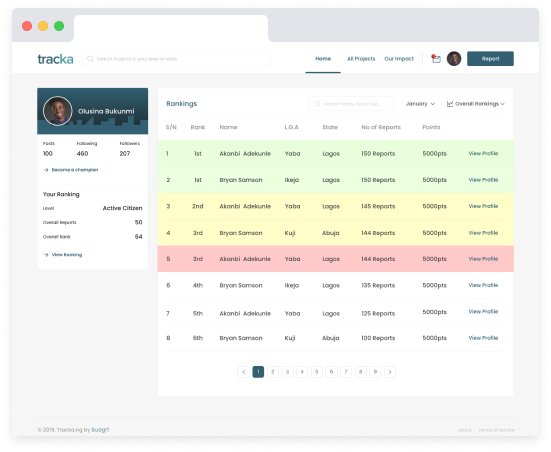
Olusina Bukunmi
Posts 100Flwg 480
Become a champion
Level: Active Citizen
Reports: 50
Rank: 84
Rankings
January ▾
S/N
Rank
Name
LGA
State
Reports
Points
1
1st
Akonbi Adekunle
Yaba
Lagos
150
5000
2
1st
Bryan Samson
Ikeja
Lagos
150
5000
3
2nd
Akonbi Adekunle
Yaba
Lagos
145
5000
4
3rd
Bryan Samson
Kuji
Abuja
144
5000
5
3rd
Akonbi Adekunle
Yaba
Lagos
144
5000
Citizen Rankings Leaderboard
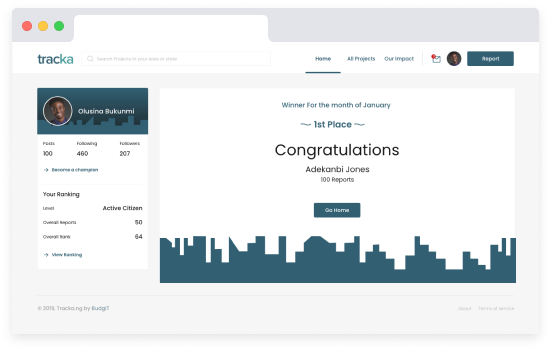
tracka.ng/rankings/winner
tracka
O
Olusina Bukunmi
Level: Active Citizen
Reports: 50
Winner For the month of January
~ 1st Place ~
Congratulations
Adekanbi Jones
100 Reports
Go Home
Monthly Winner Announcement
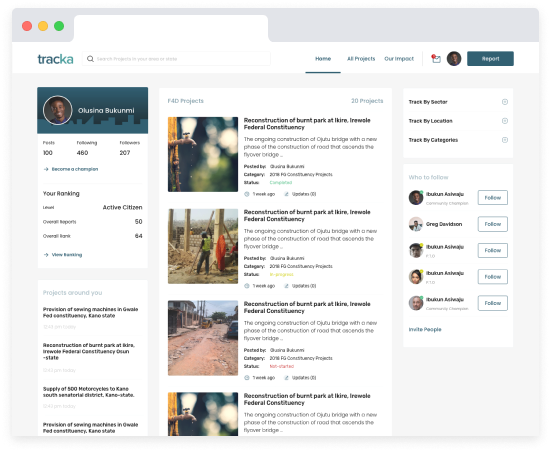
tracka.ng/projects
tracka
O
Olusina Bukunmi
Active Citizen · Reports 50
Projects around you
Provision of sewing machines
Reconstruction of burnt park
Supply of 500 Motorcycles
F4D Projects 20 Projects
🏗️
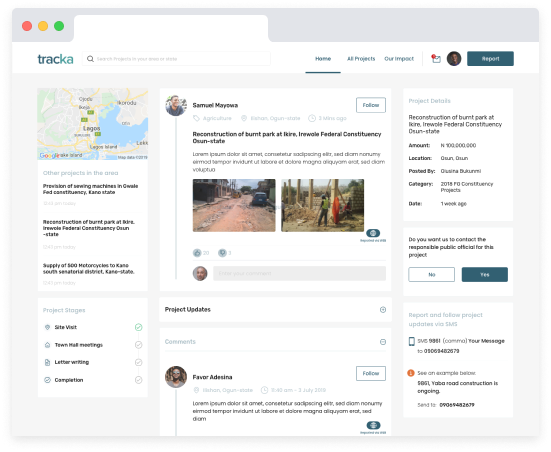
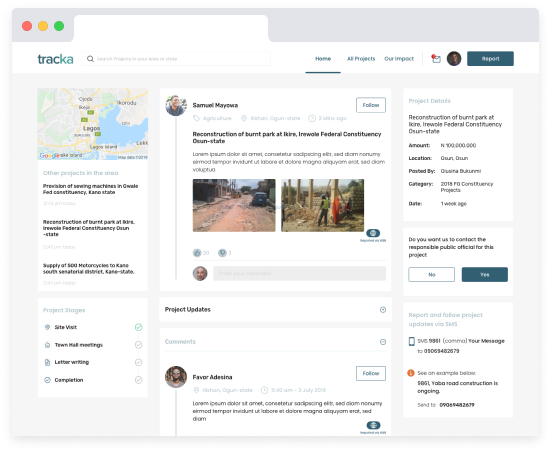
Reconstruction of burnt park at Ikire, Irewole Federal Constituency
Category: 2019 F0 Constituency Projects
Posted by: Olusina Bukunmi · 1 week ago
🧱
Reconstruction of burnt park at Ikire, Irewole Federal Constituency
Category: 2019 F0 Constituency Projects
Posted by: Olusina Bukunmi · 1 week ago
Government Projects Feed
tracka.ng/projects/detail
tracka
Other projects in the area
Provision of sewing machines in Gwale Fed...
Reconstruction of burnt park...
Project Stages
Site Visit
Town Hall
Letter writing
Completion
S
Samuel Mayowa
Follow
Reconstruction of burnt park at Ikire, Irewole Federal Constituency Osun state
🏗️
🧱
Project Details
Amount:
₦100,000,000
Osun, Osun
1 week ago
Contact official?
No
Yes
Project Detail & Tracking
🖥️ Final Screens

Tracka, screen by screen

Browse the actual Tracka screens, from project discovery and community tracking to feedback submission and leaderboard engagement.
Tracka Rankings
Rankings Leaderboard
Tracka Winner
Monthly Winner Announcement
Tracka Projects Feed
Government Projects Feed
Tracka Project Detail
Project Detail and Tracking
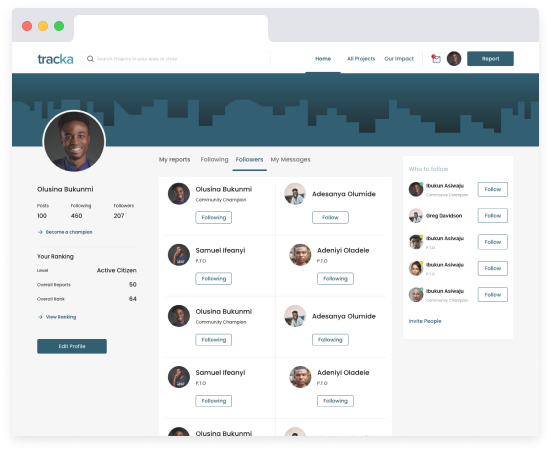
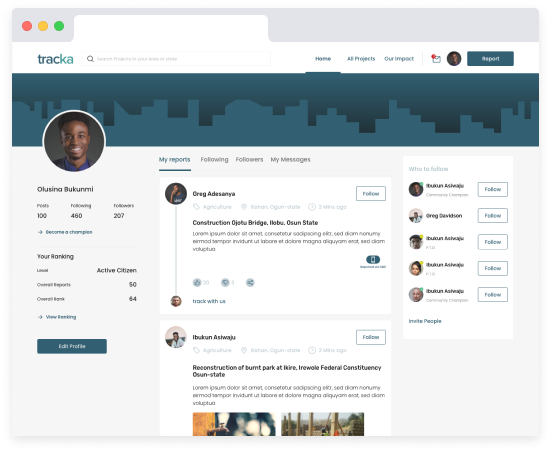
Tracka Community
Community Engagement View
Tracka Notifications
Project Notifications
Tracka Map View
Map View and Discovery
06 Design Decisions

The calls I made, and what I rejected.

Every design has forks in the road. These were the decisions that shaped Tracka most, and why I made them.

Decision 01
Geography first discovery, not keyword search
Users wanted to know what was happening near them, not search for a project name they'd never heard of. I redesigned the entire discovery flow around a map first model where citizens browse projects by location, not text. Task completion in testing improved significantly as a result.
What I rejected: A search bar as the primary entry point, which stakeholders initially requested. Testing showed that non urban users had no idea what to search for. Location removed the barrier entirely.
Decision 02
Two separate interfaces, not one shared product
Citizens and government agents had fundamentally different mental models, trust levels, and task flows. I built two distinct interfaces, citizen app and agency dashboard, rather than a single product trying to serve both. Each was designed around its user's specific context and literacy level.
What I rejected: A role based toggle within one interface. This felt efficient in design but created confusion in testing, users didn't understand why their view changed or what they had access to.
Decision 03
Follow, don't just submit, repeatable engagement
The civic engagement model was designed for repeat behaviour, not one off complaints. Citizens could follow a project, receive status updates, and see that their feedback had reached the right agency. Closing the feedback loop visibly was the mechanism that drove 3K+ active users, not just downloaders.
What I rejected: A simple feedback form with no confirmation or follow up. Early prototypes felt like shouting into a void. If users couldn't see that something happened, they didn't come back.
Decision 04
Community leaders as a third user, not a stretch persona
Running research with NGO organisers and community leaders, not just urban professionals, revealed a critical third user type I hadn't originally designed for. I adjusted the information architecture to let community leaders aggregate feedback across multiple projects, which shaped the agency facing dashboard significantly.
What I rejected: Treating community leaders as power users of the citizen interface. They had entirely different reporting needs that a citizen first model could never accommodate.
06 · Reflection

What this project taught me about designing for impact

What worked well
Co designing with the community
Running feedback sessions with actual community leaders not just urban professionals surfaced critical usability issues early. Their input shaped the location first discovery model.
What I'd do differently
Design for offline access from day one
Many users in rural areas had inconsistent connectivity. Offline mode was added late in the project. I'd now make offline first a design requirement from the very first sprint.
Senior level insight
Adoption is a design problem too
Building the app was 40% of the challenge. The other 60% was designing onboarding and community outreach materials that got citizens to try it in the first place.
Impact achieved
3,000+ citizens tracking live projects
Within the first few months of launch, over 3,000 active users were following and submitting feedback on government projects demonstrating real civic engagement at scale.
Next Case Study
Paymack Money Transfer & Bills Payment Gateway
View Next Project →